Why Automated Content Generation Fixes Your Empty Monday Calendar

Automated content generation solves the problem most solo marketers and small-business owners quietly share: the calendar that looks full on Friday and empty again by Monday. When publishing consistently feels like a second job, the real cost is not just lost time, it is the irregular presence that undermines every other effort you make to stay visible.
Introduction
Picture the marketing manager who blocked off Friday afternoon to get ahead, who built out the whole next week in a spreadsheet, color-coded by channel, feeling genuinely organized for once. By Monday morning, two client fires and a product update had collapsed the plan entirely.
For solo marketers and business owners writing their own material, that fragility is not a personal failing. It is a design problem. The real question is what a publishing system actually needs to withstand a normal week, and why most approaches quietly assume a level of capacity that was never there.
Your Content Calendar Is Not a Discipline Problem
Consider this: it's the last Friday of the month, and you've spent ninety minutes crafting the perfect editorial calendar. Color-coded by platform, topics mapped to campaigns. You close the laptop feeling accomplished. Monday comes, and the fridge is empty, or filled with very few items.

This scenario isn't about laziness; it's a systems problem disguised as guilt. An analysis on dev.to explains it plainly: the tool doesn't match your actual workflow. Your calendar shows a slot and a topic, but not where the finished piece comes from or when it's due. Empty slots feel like personal failure. Revenue-generating work kept the business afloat that week, yet guilt remains.
Recognizing this rhythm as structural, not motivational, is the first step toward fixing it. Automated content generation fits here, not as a strategy replacement, but as the infrastructure that bridges the gap between a calendar topic and a published piece. The issue was never planning. It was the production pipeline.
How Automated Content Generation Gets Confused With an Actual Strategy
Here's where confusion arises, costing valuable time. Someone might turn to automated tools to fill blank slots in a content calendar. And they are. Problem solved.
But the calendar wasn't the bottleneck.
Rato Communications discusses this clearly: content calendars fill up, topics get brainstormed, but results remain elusive due to misalignment. Automated tools can accelerate production without touching this core issue. Publishing posts aimed at the wrong audience, or covering topics nobody searches, just means creating content nobody reads, faster.
The gap between a scheduling tool and an effective editorial workflow is where plans often collapse. A calendar tells you when to publish, but not why, for whom, or what the reader should do after. Without content pillars and audience clarity, teams run out of meaningful content before the month ends, and AI assistance won't change that.
Strategy requires something else entirely. Confusing these two things is why businesses invest in new tools yet still face empty queues on Monday.
Before queuing automated content, audit your last ten published posts to identify which ones performed best. Use these as your AI tool's structural brief, not a blank prompt. Automated generation defaults to average output without guidance; feeding it proven formats gives it a pattern to replicate. This shifts the tool from a slot-filler to something that actually sounds like your brand while cutting the time you'd otherwise spend reformatting and correcting before publishing.
Why Lean Teams Are Especially Vulnerable to Calendar Collapse
Imagine a solo marketer at a mid-size HVAC company in Ohio. She manages email alongside social media; blog post calendars demand attention too, along with trade show scheduling, often while fielding sales team inquiries. Content gets created when client work allows. When it doesn't, the editorial slot quietly disappears. The week moves on.
This fragility is structural, not personal. Dev.to reports that 72% of solopreneurs cite overwhelm and scope creep as primary challenges, with content creation consistently the first thing deprioritized. When one person handles the entire pipeline, a single busy week can disrupt every stage at once.
Approval bottlenecks make it worse. A draft sits waiting for a business owner's review, the publish window passes, and instead of rescheduling, the slot simply vanishes. Raka's guide emphasizes the importance of clear ownership and defined deadlines in content calendars. Without these, review limbo becomes the default state.
Shared ownership and strict approval deadlines aren't luxuries for well-staffed marketing departments. They are essential infrastructure for lean operations, and no automated tool can substitute for them.
The Case Against Downloading Another Template
Solo marketers know this moment well: the calendar is empty again, and the instinct is to fix the container rather than fill it. Download a new Notion template. Switch platforms. Rearrange the color-coding. It feels productive because it creates something visible, and visible progress feels real.
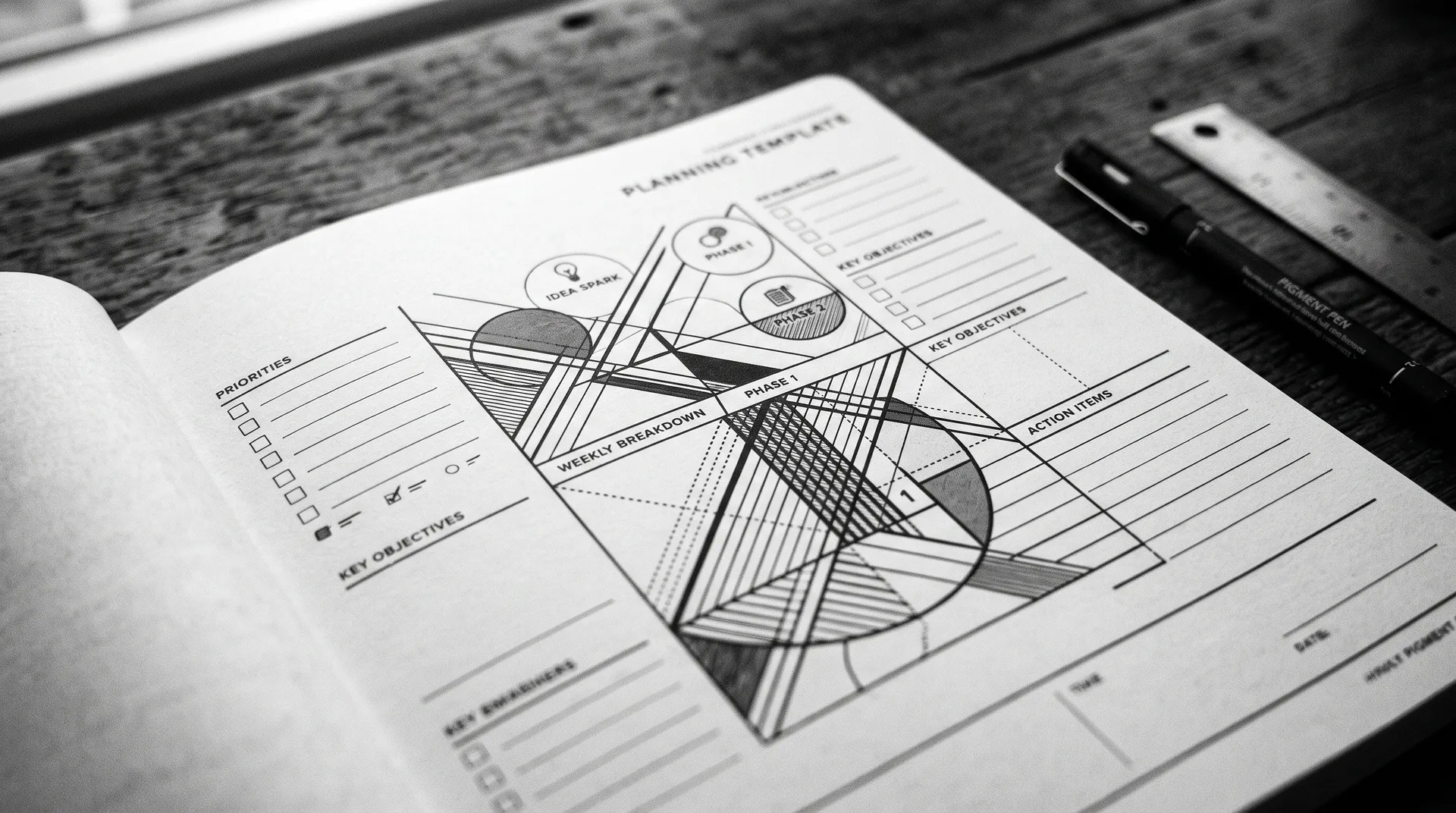
It isn't. The template is just a new grocery list for an empty fridge.
The real issue isn't structure; it's the absence of capacity and clarity about what to produce and when.
Tools improve what's already working; they don't create the habits, batching discipline, or realistic weekly cadence a functioning workflow requires. Switching platforms addresses coordination when the real obstacle is capacity. Not a platform problem. Marketers balancing multiple duties need fewer decisions standing between a topic and a published piece, because that's fundamentally a process problem, not a template one.
Instead of rebuilding your system, audit the last few pieces of content you actually completed. Identify what made them happen. Most business owners find a pattern, a specific time of day, a client question that sparked the idea, or a format that required minimal effort. Replicate those conditions deliberately, rather than designing an elaborate new workflow. If a post got written because a customer asked a question on Tuesday afternoon, that's your real content system. Build around it, not around a template designed for a team of five.
What a Calendar That Actually Gets Used Looks Like
Think of it this way: a meal plan works when groceries are already in the fridge before the week starts. Same principle applies here.

A functioning editorial workflow is built around actual capacity, not aspirational output. Choose a cadence sustainable at roughly 70% of your best week, because your best week isn't typical. Consider the HVAC marketer juggling client inquiries while managing trade show preparation. Perfect weeks don't exist. She plans for the hard ones.
Beyond cadence, what separates a surviving calendar from an abandoned one is whether ideation and drafting get time-blocked as appointments, or whether review remains vague intentions. Raka lists a named owner and due date among other essentials; the publish date itself functions as a calendar must-have. Without all three, work drifts.
Accountability matters more than most people expect. A shared deadline, visible to even one other person, changes behavior. Once a topic is chosen, that choice still needs a scheduled moment and someone responsible for making it.
That's the entire system. Not a color scheme. A production rhythm with names attached.
Conclusion
Empty Mondays are not a character flaw. They are what happens when a system that was never built to run on its own is asked to run on its own, week after week, on top of everything else you already carry. Automated content generation does not fix that by replacing your voice, it fixes it by removing the friction that was quietly winning. Stop downloading templates. Stop scheduling "content days" that disappear by Tuesday. Build something that actually runs, or let something help you build it. Your calendar should not feel like a dare.
Sources
- How to Create a Social Media Content Calendar | Worcester State University
- Content calendar template | monday.com
- Why Your Content Calendar Dies After 3 Months (And the System That Actually Survives)
- 7 Causes of Content Calendar Chaos—and How to Solve Them [2026] • Asana
- Strip programming - Wikipedia
- How to Overcome Common Content Strategy Challenges
- It’s All About The Timing: Efficiency Via Content Calendar Use for Social Media Marketing
- How to Keep Your Content Calendar on Track - Raka